


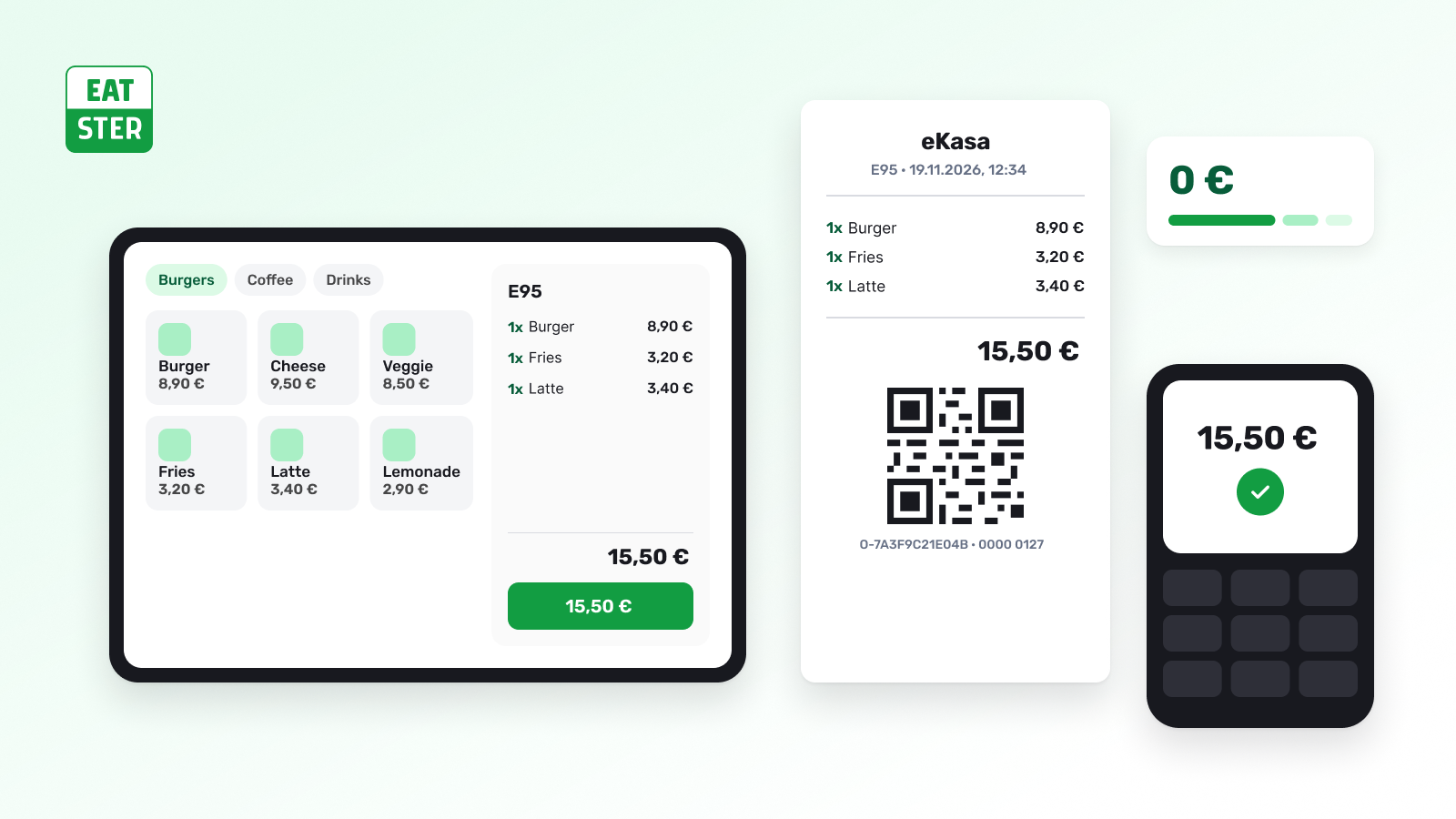
How much does eKasa cost? There is no single number. The real eKasa cost is made up of several parts – the device or software, a printer, internet, service and, above all, card payment fees. Since 1 January 2026, Slovakia's new sales recording act (No. 384/2025 Coll.) has been in force, introducing software cash registers, and since 1 May 2026 sellers must let customers pay without cash. If you run or plan a restaurant, café or food stand in Slovakia, this guide explains what an eKasa cash register really costs, how the three register types compare and how to calculate the total over three years.
Who needs an eKasa cash register in 2026
Under the new act, sellers must record sales in the eKasa system of the Financial Administration and use a register at every point of sale. The act removed most of the previous exemptions, so the obligation now covers almost everyone who accepts cash or card payments. For restaurants, bistros, cafés and stands, an eKasa register is a fixed cost of doing business – and one worth planning carefully.
The three register types and what they cost
Slovak law recognises three types of eKasa registers. All of them send data to the same system, but they differ in where the software runs, what hardware they need and how you pay for them.
VRP – virtual cash register
The virtual register is a free service from the Financial Administration, used through its mobile app and web portal. The software costs nothing, but you need your own phone or tablet, an internet connection and, if you want to print receipts, a printer. Mobile printers for VRP typically sell for around €100 to €200. VRP suits very small businesses with few sales. It does not connect to the kitchen, tables, stock or self-service channels.
ORP – classic online cash register
A classic register is a certified device with POS software and a protected data storage. It is usually a one-off purchase. Sellers in Slovakia offer basic certified registers from roughly €250–300, while more capable touchscreen systems for hospitality cost several hundred euros to over €1,000. Service, installation and updates may come on top.
SORP – software cash register
The software online cash register is new under the 2026 act. The POS software and protected storage can run on a standard tablet, a PC or in the cloud, so no special fiscal printer is needed. It is usually paid as a monthly licence. We explain it in detail in Cloud eKasa in Slovakia: what is a software cash register (SORP)?

eKasa cost: what the total really includes
The device price is only the visible part. To compare offers fairly, add up these items over the same period – ideally three years:
- Register or licence – a one-off device price or a monthly software fee.
- Extra hardware – tablet, receipt printer, cash drawer, kitchen printer or display.
- Payment terminal – purchase, rental or monthly fee.
- Card processing fees – a percentage of every transaction.
- Internet – fixed line or mobile data, ideally with a backup.
- Service and support – repairs, updates and weekend availability.
- Staff time – retyping orders and mistakes between counter and kitchen never appear on an invoice, but they cost money.
Card fees: the biggest cost you don't see at first
Since 1 May 2026, sellers in Slovakia must offer a cashless option for purchases over €1. You choose the method – a card terminal, card payment on a kiosk, a QR payment or another option. For hospitality, that makes card fees part of every cash register budget.
The fee has several layers: the interchange fee, which the EU caps at 0.2% for consumer debit and 0.3% for consumer credit cards; card scheme fees; and the payment provider's margin. The margin is where offers differ most. As an illustration: if a business takes €25,000 a month by card and one offer is 0.4 percentage points more expensive, it pays an extra €100 a month – €3,600 over three years. That is often more than the register itself.
The cost of not having a register: fines
The new act raised penalties. Failing to record a sale in an eKasa register can cost €1,500 to €20,000 the first time and €3,000 to €40,000 for repeated breaches. Recording a sale but not handing over the receipt carries a fine of €150 to €6,500. For cashless payments, the tax office issues a warning instead of a fine the first time; a second breach can mean a fine of €500 to €15,000. Saving on the register simply does not pay off.
What changes in 2027
The sales recording act does not set any new fixed deadlines for 2027 so far. Some technical obligations will take effect on a date the Financial Directorate announces, and a certification decision for POS software is valid for up to five years. When choosing a register, check that the vendor keeps it updated and who is responsible for certification. For legal questions, always ask your accountant.
Which register suits which type of business
- A stand or small outlet with few items – VRP or a simple register may be enough to start. Card fees and a reliable mobile connection matter most.
- A café or counter-service bistro – a touchscreen POS with a fast menu, variants and kitchen printing pays off. At higher volumes, the card rate matters more than the device price.
- A full-service restaurant – you need tables, split bills and a link to the kitchen. A standalone register can cost you more in staff time than you save on the licence.
- A food court, stadium or festival – several points of sale, kiosks and short rushes. A software solution lets you add another point of sale without another fiscal printer.
Whatever your type, think about growth. If you plan to add a kiosk or QR ordering next year, choose a register that can handle them without migrating your data.
How to compare offers: a three-year calculation
- Know your card turnover. Estimate monthly revenue and the share paid by card and phone.
- Multiply by each offer's rate. That gives monthly payment costs; multiply by 36.
- Add the register or licence. The one-off price or 36 monthly fees.
- Add hardware and the terminal. Printers, tablets, kitchen display and terminal.
- Add service and internet. Including a backup connection.
- Compare the total. The cheapest device is not always the cheapest register.
Questions to ask a cash register vendor
- Does the solution hold a valid certification decision from the Financial Directorate?
- What is the exact card rate, and does it differ by card type?
- Is there a monthly fee for the terminal or for each device?
- How does the register handle internet outages, and who fixes it when it fails?
- Does it connect to the kitchen, kiosks and QR ordering without extra systems?
- How long is the contract, and what does early termination cost?
A POS from €0 a month in the Eatster ecosystem
The Eatster POS has licences from €0 a month with the lowest card fees – see current terms on our pricing page. The POS, self-service kiosks, QR ordering at the table, the mobile app and the kitchen display run in one system with one menu and one set of reports. Orders placed through the Eatster ecosystem are on average 15% higher, and businesses can save up to 25% of operating costs. Eatster handles more than 100,000 transactions a month in 3 countries, with clients such as Aupark, Cassovar, X-BIONIC SPHERE, HC Slovan and OC Laugaricio – see our customers.
Summary
The cost of an eKasa register is more than the device price. VRP is free but limited, a classic register is mostly a one-off purchase and a software register is paid monthly. Card fees, hardware, service and staff time decide the real total. Add everything up over at least three years and compare every offer the same way.
Want to know what a POS would cost in your business? Try the demo or get in touch.

