


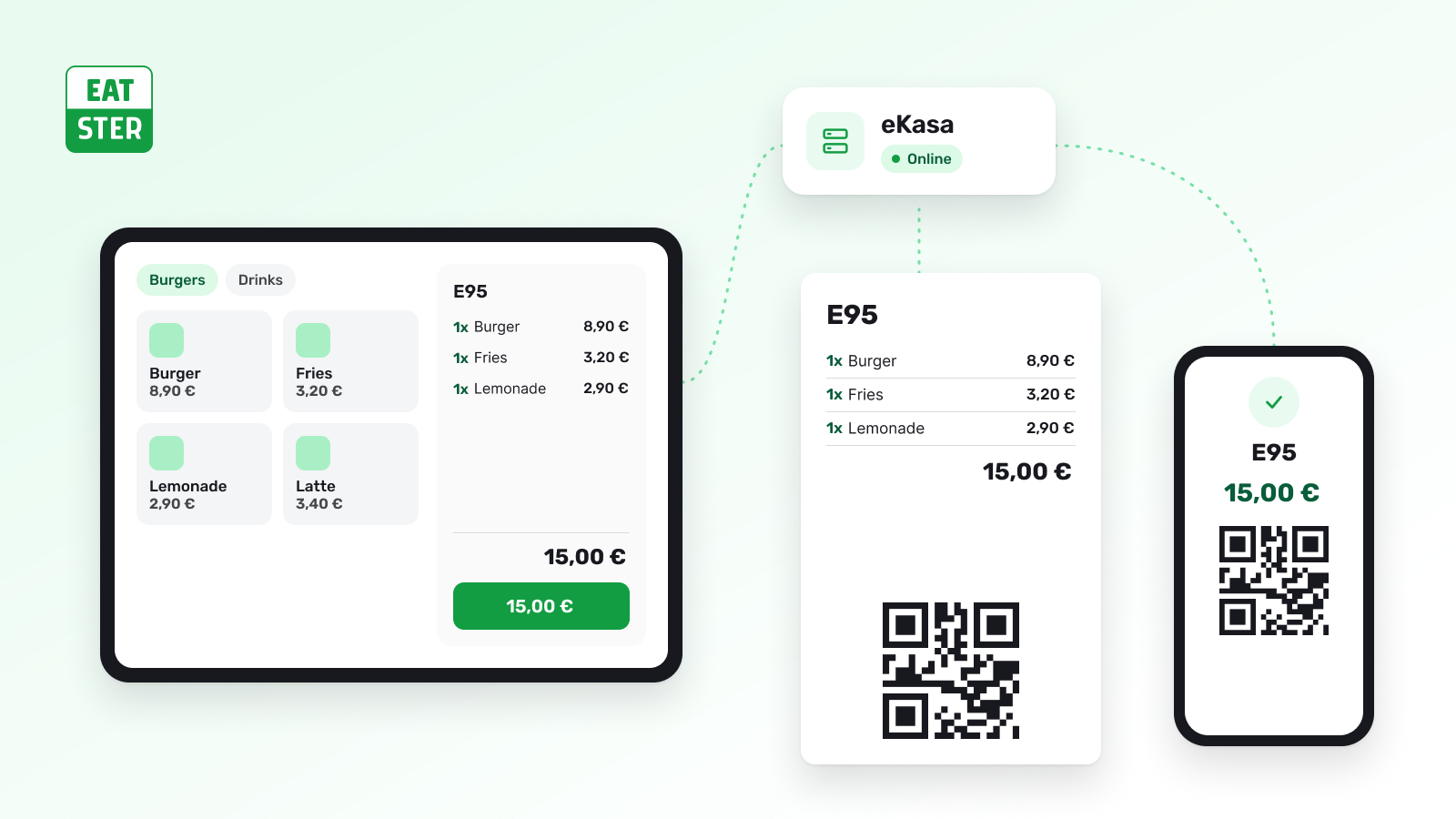
Since 1 January 2026, Slovakia has a new way to record sales: cloud eKasa. Act No. 384/2025 Coll. on sales recording introduced the software online cash register – in Slovak softvérová on-line registračná pokladnica, or SORP. Instead of a dedicated fiscal printer with a hardware storage chip, certified software running on a tablet, a PC or in a remote (cloud) environment can now send every sale to the eKasa system of the Financial Administration. If you run a restaurant, café or food stand in Slovakia – or are planning to – this guide explains what SORP is, how it differs from the other register types and who it suits.
What is a software cash register (SORP)?
Slovak law recognises three types of eKasa registers. Under § 2 of the Act, a software online cash register is a set of POS software and a protected data storage that communicates with eKasa. Unlike a classic online register, it does not need special fiscal hardware: the software runs on equipment the seller controls, and both the software and the protected storage may sit in a remote environment.
In practice, your register can be an ordinary tablet or computer with an app. Receipts can be printed on a standard printer or sent electronically. For venues with several points of sale, kiosks or seasonal stands, this is far more flexible than a traditional cash register.
ORP, SORP and VRP: the three eKasa register types
- ORP (online cash register) – the classic setup: POS software, a protected data storage and hardware that talks to eKasa through an integration interface.
- SORP (software online cash register) – software and protected storage running on the seller's own hardware or in a remote environment, with no special fiscal printer.
- VRP (virtual cash register) – a free service from the Financial Directorate, used through its mobile apps and web portal. Best suited to very small businesses with few sales.
All three record sales in the same eKasa system and issue receipts with the same mandatory details. The differences are where the software runs, what hardware it needs and how well it connects to the rest of your operation.
How cloud eKasa works day to day
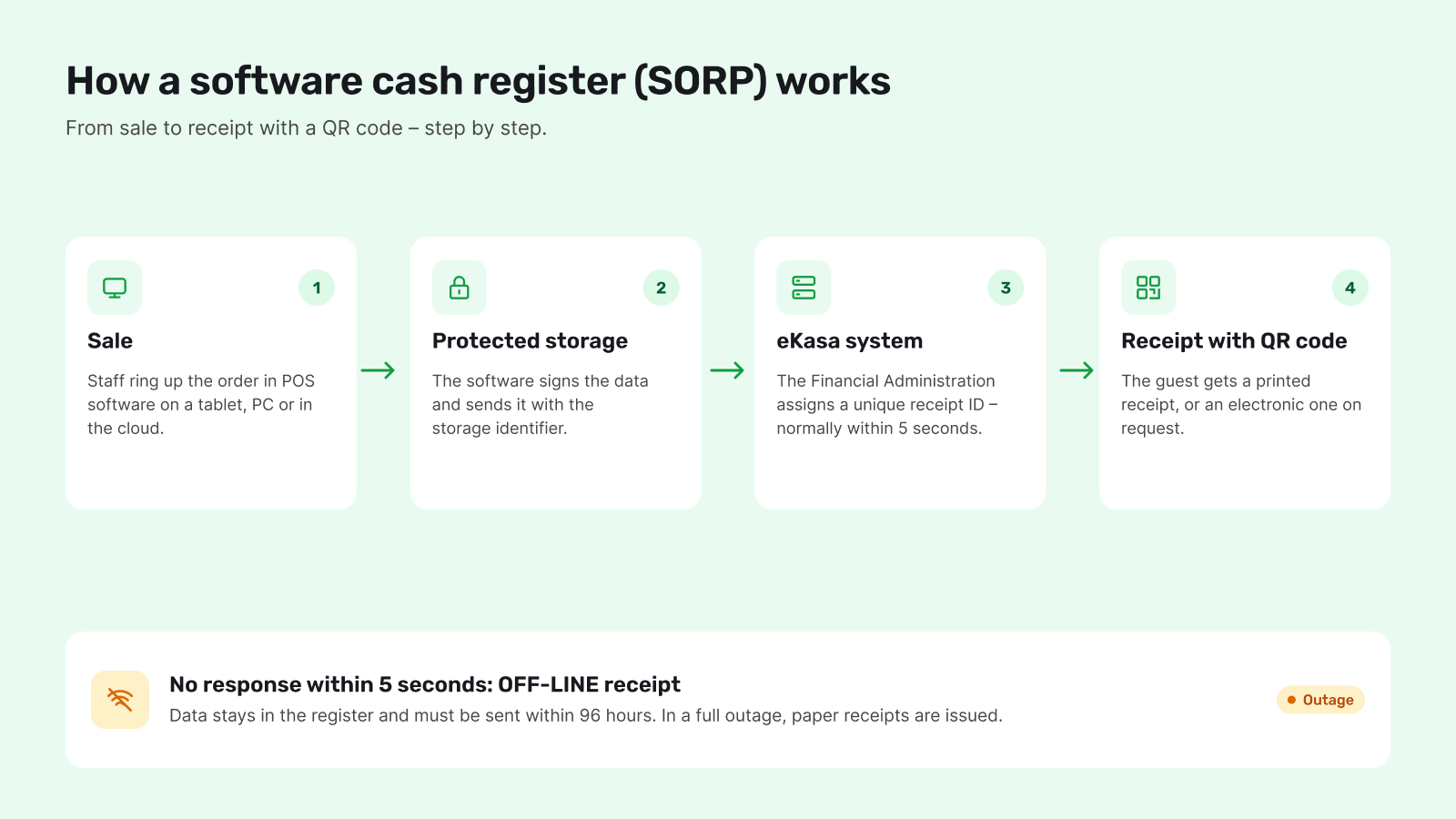
With every sale, the POS software creates a data message, signs it and sends it to eKasa together with the identifier of the protected storage. The Financial Administration returns a unique receipt ID that anyone can use to verify the receipt. Each receipt must show a QR code, the receipt ID and a verification code.
The response time limit is five seconds. If eKasa does not answer in time, the register issues a receipt marked OFF-LINE, stores the data message and must send it to eKasa within 96 hours of the first attempt.
You can print the receipt or send it to the guest electronically. An electronic receipt is valid when the customer agrees and asks for it before printing, and the receipt is then not printed.
Requirements a SORP has to meet
- Certification – the protected data storage needs a certification decision issued by the Financial Directorate of the Slovak Republic. A decision is valid for up to five years.
- eKasa register code – the tax office assigns a code to every register; without it, you cannot record sales.
- Mandatory receipt details – receipt ID, a readable QR code, signature and verification codes.
- Every point of sale – an eKasa register must be used wherever you take payments.
Before signing a contract, always check that the specific solution holds a valid certification decision. The Financial Administration publishes a list of certified registers.
Internet outages and register failures
If the register cannot operate – because the internet, the remote environment or the device itself fails – the seller issues paper receipts (paragón) in two copies: the original for the customer, the copy for the venue. These must be entered into the register within ten days after it is back in service.
In case of a device failure, the register must be running again no later than 96 hours after the end of the day the failure occurred, or the seller must switch to another register. A loss of internet signal does not count as a failure. A good software register should handle short outages automatically and resend pending data on its own.
What a cloud POS changes for restaurants
The biggest shift for hospitality is that the cash register is no longer one box behind the counter. When software records the sales, it can be part of your whole ordering system:
- Table service – staff take orders on a tablet or phone and the guest gets a receipt without a trip to the counter.
- Self-service – orders from kiosks, table QR codes or a mobile app are recorded in the same system as counter sales.
- Less paper – when a guest asks for an electronic receipt, nothing needs to be printed.
- Easy expansion – a new point of sale on the terrace or at an event means another device with an app, not another fiscal printer.
- Remote updates – when rules change, the vendor can update the software without replacing hardware.
Keep in mind that responsibility for correct sales recording stays with the seller. Make sure it is clear who handles outages, paper receipts and checks.
Who is cloud eKasa for?
- restaurants and bistros that want the register on a tablet and electronic receipts,
- food courts and shopping centres with several vendors and self-service kiosks,
- stadiums, arenas and festivals that need to add or remove points of sale quickly,
- multi-site chains that want one menu, one price list and central reports.
A very small business with a handful of sales a day may be fine with the free VRP. Its drawback is that it does not connect to the kitchen, stock or self-service channels.
Mandatory cashless payments since 1 May 2026
The same Act requires sellers to let customers pay without cash for any purchase over €1. This obligation applies from 1 May 2026. The seller chooses the method – a card terminal, card payment on a kiosk, a QR payment or another option. There is an exception where no internet signal is available or payment confirmation services are down.
A first breach results in a warning, a second one in a fine of €500 to €15,000 and any further breach in a fine of €3,000 to €40,000. That is one more reason to use a register that handles card and QR payments without extra devices.
How to choose a software cash register: a checklist
- Certification – does the solution hold a valid decision from the Financial Directorate?
- Offline mode – how does it handle outages and resend data within 96 hours?
- Receipts – can it print on standard printers and issue electronic receipts?
- Payments – cards, QR payments, kiosk and in-app payments?
- Integrations – is it connected to a kitchen display, kiosks, QR ordering and stock?
- Total cost – licence, card fees, hardware and support over at least three years.
Eatster: one POS connected to every channel
Eatster brings the POS, self-service kiosks, QR ordering at the table, a mobile app and a kitchen display together in one system with one menu and one set of reports. Licences start at €0 per month with the lowest card fees, orders placed through the Eatster ecosystem are on average 15% higher, and venues can save up to 25% of operating costs. Eatster handles more than 100,000 transactions a month in 3 countries, with clients such as Aupark, Cassovar, X-BIONIC SPHERE, HC Slovan and OC Laugaricio – see our customers. Current plans are on our pricing page.
Summary
Cloud eKasa lets Slovak businesses record sales without dedicated fiscal hardware – on a tablet, a PC or in the cloud. What matters most is certification, behaviour during outages and how well the register connects to the rest of your venue. For legal questions, check with your accountant, as the rules change often.
Want to see how Eatster would work in your venue? Try the demo or get in touch.

